
09 Jan “We are here, we have rights and we can work”. My experience as peer-researcher in the Netherlands – by Hamo Salhein
My name is Hamo Salhein from Sudan.
I used to speak out about human rights in Sudan until I ended up feeling unsafe in Sudan and had to leave. I decided not to work in this field and to start a normal life in the Netherlands. I came in 2018. In 2020, my application for asylum was rejected, and I became an undocumented person in Amsterdam. At that time, after that experience, I decided to become an activist for the rights of undocumented people. It was very difficult for me to speak out, and even more difficult for me to find someone to listen to me.
In 2022, I got my residency permit, and now I can tell the world what it’s like to be an undocumented person living in the beautiful city of Amsterdam.
I decided to develop myself in this field and work as an activist again. Working with PICUM in the DignityFIRM project, doing a Participatory action research together with undocumented people working in the food industry, was one of the greatest opportunities through which I could listen to problems, think of solutions, and also provide all the necessary equipment to make the work more effective.
We held focus groups together with undocumented people working in the food industry. Together with this group, we first discussed issues they experienced in their lives as undocumented workers and at work, and then thought of ideas for action to take collectively. The surprise for me personally after listening to the participants was that the system had implanted in their minds the idea of becoming part of society as a lifelong dream. This placed a ceiling on their dreams and erased all the real dreams they had fought for until they reached safety{EU}. No one was dreaming of having a big house or a luxury car; people were dreaming of having their basic rights.
I also noticed that as an undocumented person, you are often dependent on others to support you in speaking out. When I was in one of the shelters in Amsterdam and I saw it was not in the best condition, I thought I could speak out to make it better. But I was afraid to lose the roof above my head and the bed I slept in.
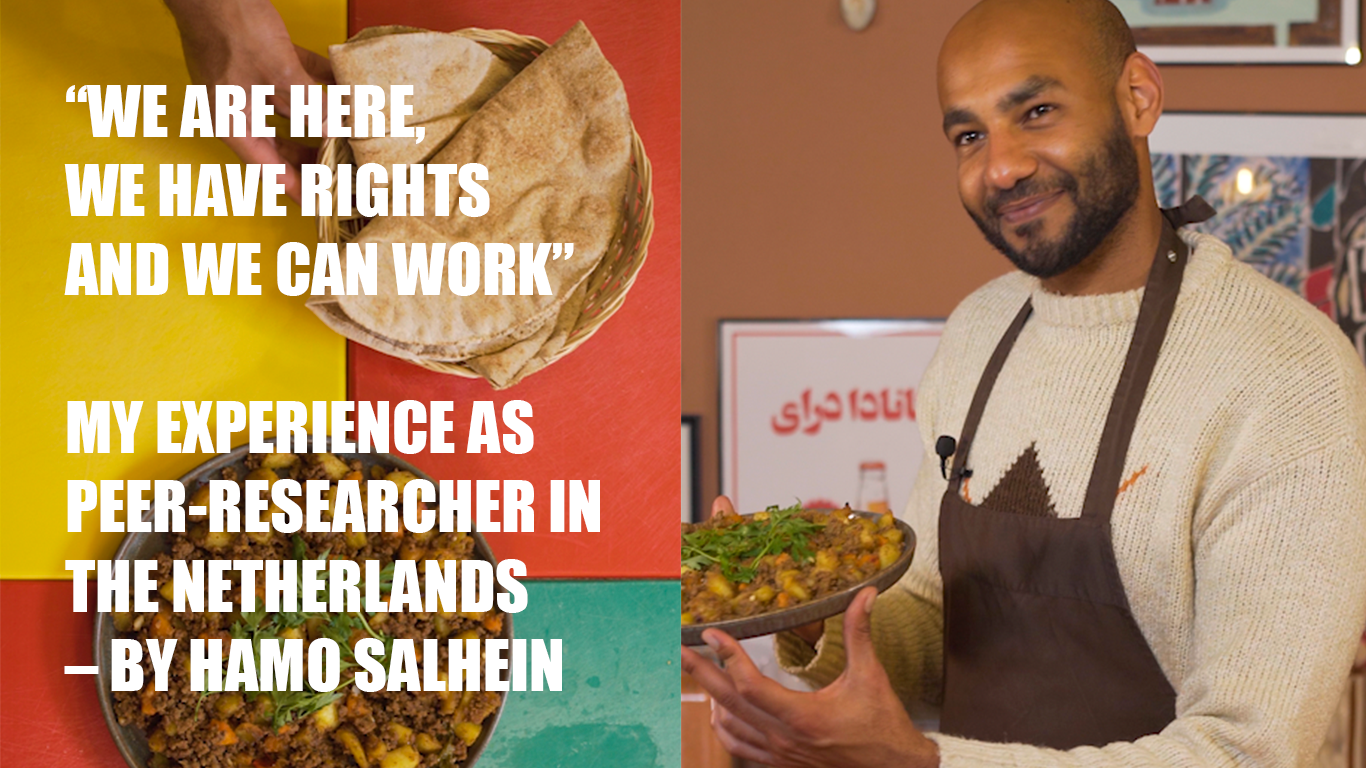
After listening to the ideas within the focus groups, we decided, as a team, to deliver our message through cooking videos and podcasts that explain some of the struggles and solutions. We created videos. In these videos, we talk about regularisation through work while we are cooking our favourite dish at the same time. We are creating a campaign fighting for the regularisation of undocumented people through work. For this campaign, we collaborate with partner organisations and the FNV (the labour union).
For more on the process of the Participatory Action Research in Amsterdam, Seville and Wroclaw, check DignityFIRM’s PAR Cross-country report
And you can find more information on the actions implemented in the three cities, including the regularisation campaign in the Netherlands and the cooking videos, in the Migrant organisations led actions report.