

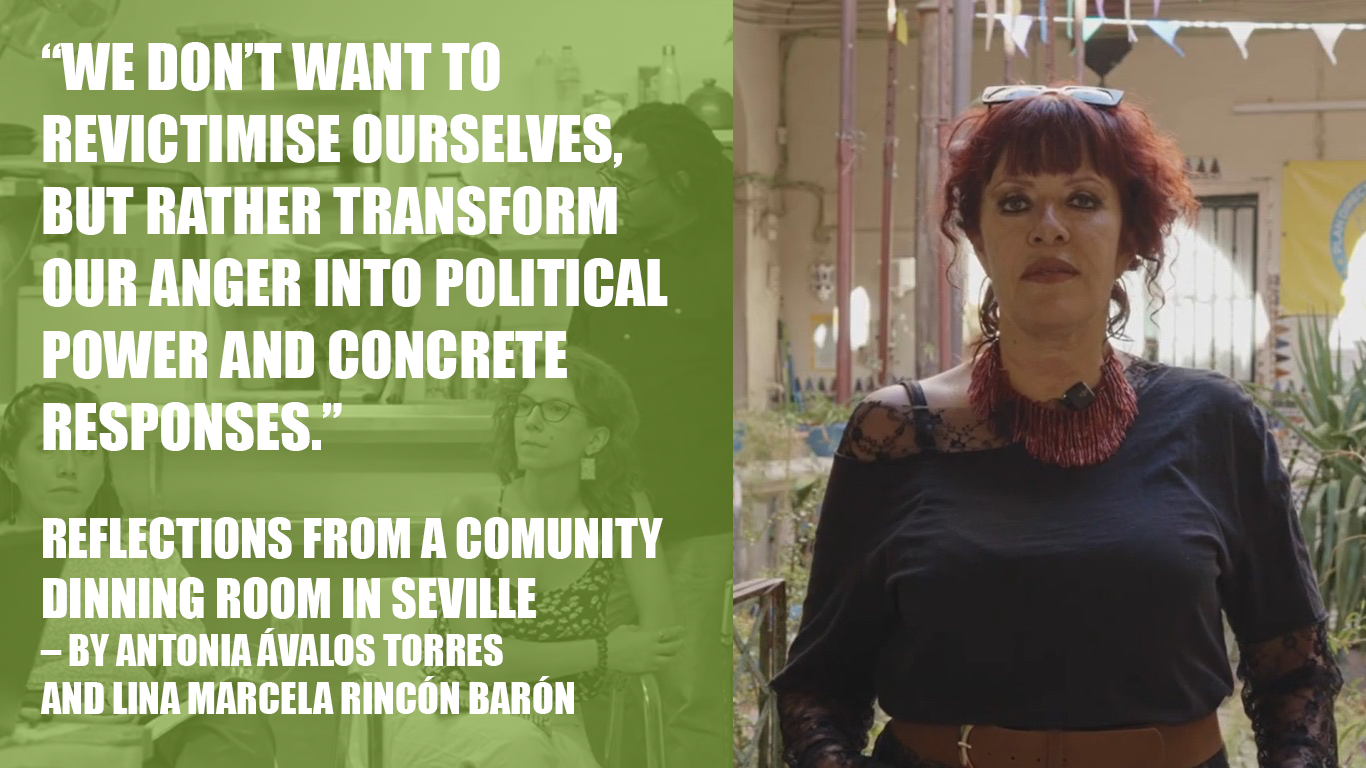
20 Jan “We don’t want to revictimise ourselves, but rather transform our anger into political power and concrete responses.” – Reflections from a community dinning room in Seville by Antonia Ávalos Torres and Lina Marcela Rincón Barón
Mujeres Supervivientes leads the Seville case study of DignityFIRM’s Participatory Action Research in Spain. Its funder Antonia Ávalos Torres and the peer-researchers in Seville Lina Marcela Rincón Barón and Roberto Cruz reflect on the project and their way of working.
The workshop in Seville raised reflections over the potential for self-organized migrant workers unions, and included the participation of Silvana Cabrera, spokesperson for the migrant-led regularisation initiative RegularizaciónYA!, and Spanish Roma lawyer and activist Pastora Filigrana, amongst others.
DignityFIRM is a project that embodies our life stories, marked by exploitation, fears, anxieties and dreams, as well as the grief involved in the migration journey. Through welcome and hospitality, we seek to create a safe and warm collective space where participants can talk and discuss their working and living conditions. This process of remembering also involves moments of stress and suffering as we relive the ‘migration wound’. As a grassroots organisation, Mujeres Supervivientes is open to the neighbourhood, without revictimising ourselves, but rather transforming our anger into political power and concrete responses for our neighbours. We meet every week, although the population fluctuates due to the rhythms of temporary work, housing and job instability, and constant mobility within the city, the country or even outside Spain.
Therefore, it is important to note that some of the people participating in this project, or their friends, are part of the political and emotional ecosystem of the networks of life and work surrounding our Community Dining Room. Our Community Dining Room is an almost extinct space in the city, a place where encounters are generated and political tenderness is practised, where we politicise our conditions of existence: work, employment, violence, body, feelings, thoughts and actions.
We have recognised that when profiling migrants working in the hospitality sector, many face situations of multiple jobholding (also devoting working time to care work, beauty salons, construction, among others), split shifts, uncertainty about their ‘papers’ and precarious housing. However, beyond these difficulties, sustaining their lives in this context is a Herculean task that requires enormous vital energy, creativity, and the support of networks of solidarity and mutual care.
In our research, we brought together a group of migrant men and women, aged between 23 and 54, from different Latin American countries and one participant from Senegal, who have been or are currently in an irregular situation. We explored what this has meant in their lives, the denial of their human rights, leading to uprooting, labour and other types of abuse, difficulties in renting accommodation and opening a bank account. It has also prevented them from carefully and respectfully addressing everything that comes with leaving their families in other countries, facing a different language, different customs, and unresolved grief.
In order to address their experiences, we focused on building and developing our methodology within the Participatory Action Research, drawing on social movements’ previous experience from an intercultural, feminist perspective based on intersectionality, creating our own rules for coexistence and care.
Our Methodology
• Group cohesion and strengthening:
We seek to create a space for group cohesion based on respect, trust, a sense of belonging, and mutual support. We encourage resilience, active listening and access to information resources. We strengthen the bonds necessary for survival, including the exchange of information on employment and care (for example, warnings such as: ‘Don’t go there, because they’ll fire you after a month’ or ‘The owner harasses the waitresses’). All this with a clear objective: to have a political impact on the neighbourhood, the city, our families, our country and the European Union, contributing to the emergence of the social political subject.
• Body, feeling and thinking as a whole:
We articulate the body, feeling and thought to avoid the fragmentation that suffering and racism generate in our lives. We incorporate tools such as breathing, biodanza and self-care as a political dimension of affections. These practices not only promoted group cohesion, but also helped people feel comfortable, confident and secure, which is a fundamental requirement for building a sense of belonging and collectivity.
• Recovery and politicisation of lived experience:
Through our personal narratives, framed within labour, human and migration rights, we promote a process of reflection and reinterpretation of our experiences. This exercise allowed us to transform the personal into the collective and convert anger into political power, making memory and words tools for liberation and action.
Finally, we would like to emphasise that the process we are undertaking to learn about the stories of the people we invite to this space is deeply revealing and confronts us with several painful realities. On the one hand, we are faced with widespread despair, a feeling that stems from the perception of a system that seems deeply entrenched and never changes, which makes many of us feel that the chances of improving our conditions are practically nil. This feeling pushes us to think that the only way to achieve a better life is to leave the hospitality sector, a sector which, despite being our main source of income, is a place of exploitation and continuous wear and tear.
Furthermore, this process also confronts us with the desire of some to obtain regularisation through papers, believing that once this goal is achieved, their lives will be easier. However, this desire is based on the hope that a document can transform living and working conditions, when in reality we know from Mujeres Supervivientes that obtaining papers does not guarantee the disappearance of inequalities and discrimination. In this process, we are forced to question what it really means to ‘be better’ in a system that continues to exclude and exploit migrants, regardless of their legal status.
_
For more on the process of the Participatory Action Research in Amsterdam, Seville and Wroclaw, check DignityFIRM’s PAR Cross-country report
And you can find more information on the actions implemented in the three cities, including the conference on self-organisation options for migrant workers’ unionizing in Seville, in the Migrant organisations led actions report.