

28 Jan Working in hospitality and professional development in Spain
By Lina Rincón, Researcher, Seville
Migrating often comes with the idea of starting over: new opportunities, new relationships, the promise of a better life. I also migrated with that expectation. However, along with that excitement came barriers that are not always visible, but are felt every day.
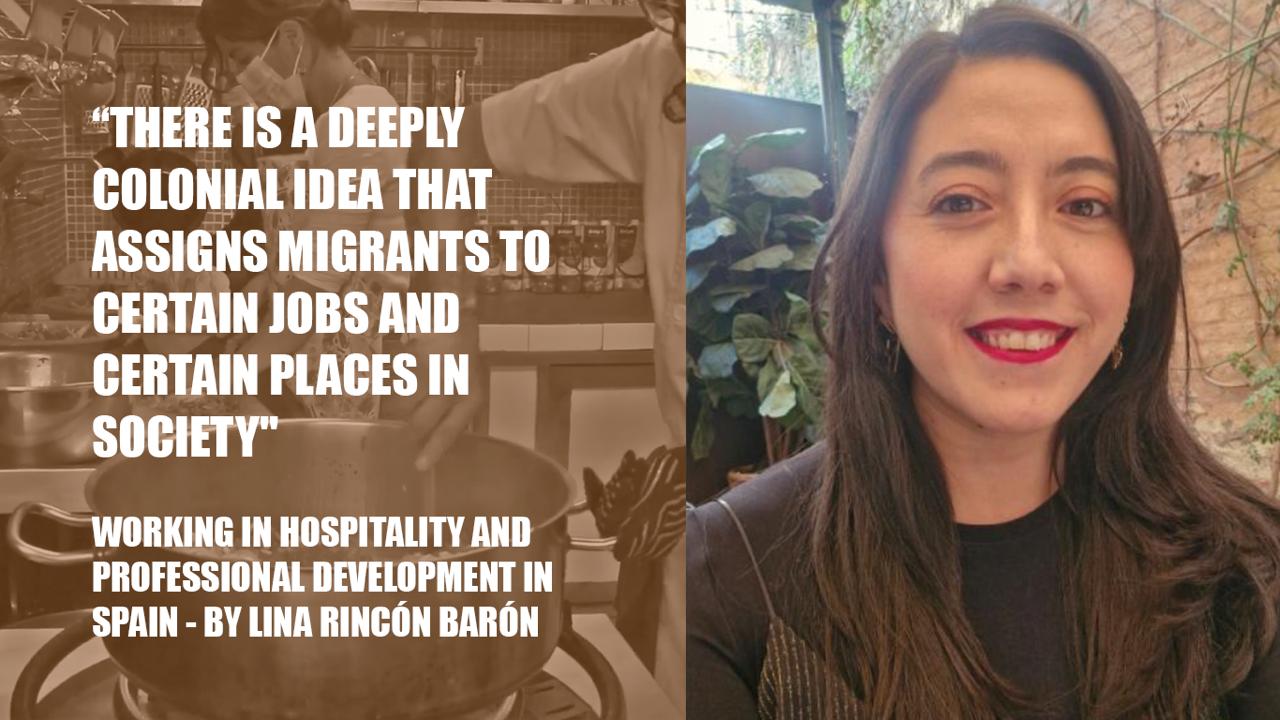
In Spain, hospitality is one of the main sectors where migrants work. Many, like me, arrive with academic training and professional careers built in our countries of origin. In Latin America, obtaining a university degree and/or postgraduate qualification is a socially recognised achievement, the result of years of personal and collective effort. Here, however, that capital seems to be erased. Not only because the recognition of qualifications can take years, but also because there is a deeply colonial idea that assigns migrants to certain jobs and certain places in society.
While it is true that one of the main barriers is the administrative situation and obtaining a work permit, even when this is achieved, working as a waitress as a professional constantly confronts the place we are allowed to occupy and the one we can aspire to. In daily interactions with customers—often tourists, people from northern Europe or the so-called ‘global north’—hierarchies are reproduced that place some as full-fledged subjects and others as mere available labour. It is not just about waiting tables, but about enduring looks, comments and attitudes that question your value, your ability and your history.
Hospitality is often presented as temporary work, as the first step towards being able to stay. At first, it can even be experienced with hope. But over time, a feeling emerges that is difficult to name: that of not being seen as a person with knowledge and experience and, worse still, that of beginning to see yourself as nothing more than that place. Colonial history not only continues to shape the labour market; it also permeates the way we think about ourselves, value ourselves and allow ourselves to imagine futures.
For all these reasons, it is necessary to continue promoting actions that highlight this reality and break with the idea that these experiences are individual or exceptional. What migrants experience in the hospitality industry is not an isolated problem. Understanding this is essential in order to think about real change: transformations that do not fall solely on individual responsibility, but are built from the community, political and social spheres, creating spaces that allow us to develop our full human and professional potential.
For more on the process of the Participatory Action Research in Amsterdam, Seville and Wroclaw, including the case study with hospitality workers in Spain, check DignityFIRM’s PAR Cross-country report.
And you can find more information on the actions implemented in the three cities in the Migrant organisations led actions report.